Part 5 – I Skipped Backlinks. Here’s Why That Was Right
I did not add backlinks.
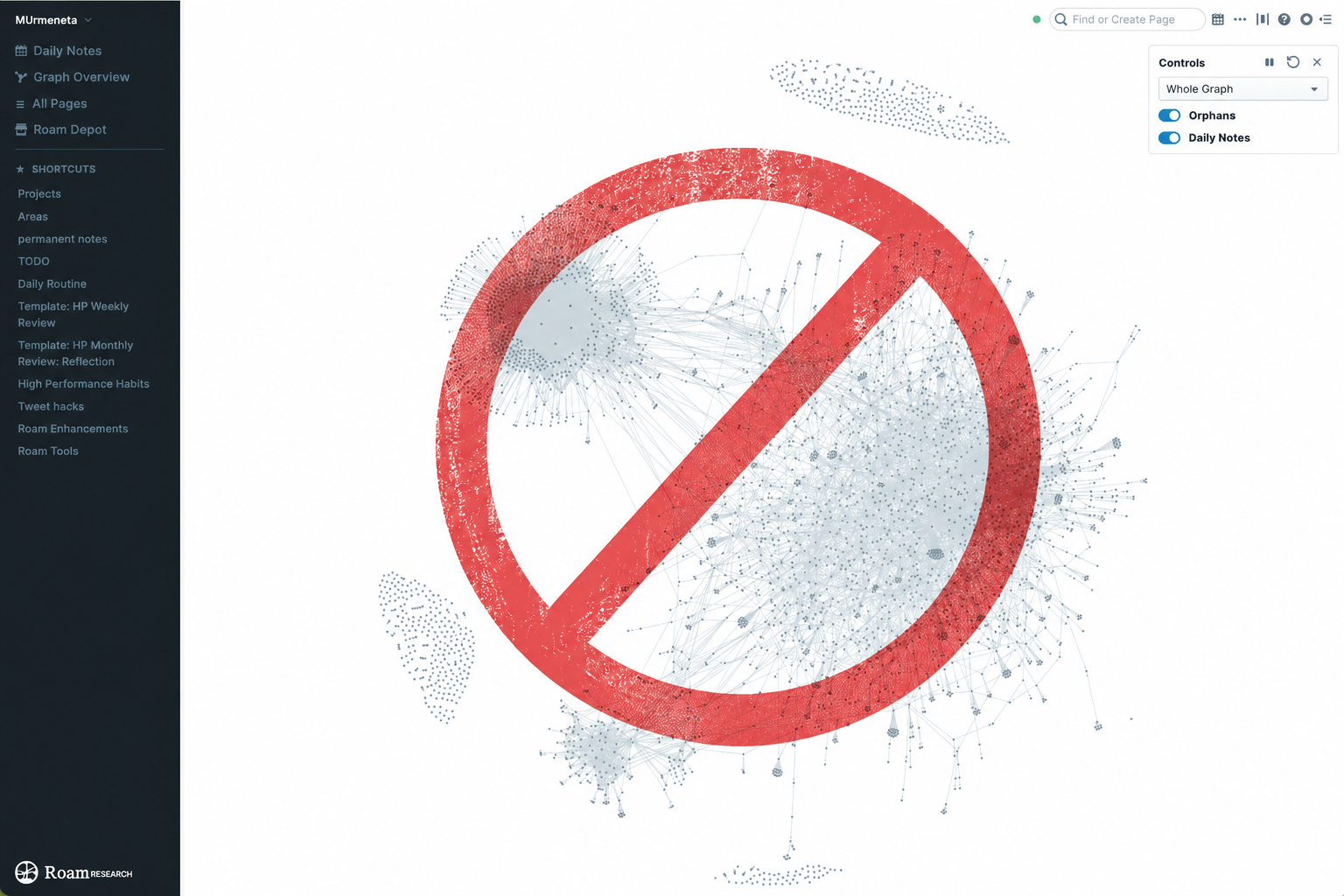
That was supposed to be the next step. The May 9 post said so explicitly. I had Obsidian pointed at the folder, the graph view was open, and the Zettelkasten people would tell you this is where the system comes alive. You start linking notes to each other. The connections accumulate. Over time the graph becomes a picture of how you think.
I looked at it for a while and decided not to.
Here is the reason, and I want to be precise about it because I think it matters beyond my particular situation.
Backlinks require you to recognize a connection at the moment you are writing a note. You are in one file, thinking about one thing, and you have to simultaneously hold the question: what else in this system does this connect to? Then you have to name it, type the brackets, and make the link. That is foresight and friction at exactly the moment when you are trying to capture something before it disappears.
I have years of Roam Research data. Thousands of notes. Hundreds of backlinks built exactly this way. I never once opened the graph view to find a connection I had not already known was there. Not because I forgot. Because browsing a graph is not how I retrieve anything. I do not wander through connections hoping something surfaces. When I need to know if two things are related, I ask. I get an answer. I move on.
The entire backlink premise assumes a particular retrieval behavior. You build the graph so you can walk it later and find unexpected connections. That is a real cognitive style. It is not mine.
What I do instead is ask Claude to traverse the files. I do not build the connections in advance. I let them get surfaced on demand, from whatever is actually in the notes, without having anticipated them at the moment of capture. The AI reads across everything. It finds the pattern. It tells me what is connected and why.
This is not a workaround. It is a different architecture for the same problem.
The backlink system is a pre-retrieval architecture. You do the connection work upfront so the graph is navigable later. The AI traversal system is a post-retrieval architecture. You capture without overhead and query when you need the connection. For someone whose mind runs on pattern recognition rather than verbal narration, the second architecture fits better. I do not need to have anticipated the connection. I need to be able to ask for it when I am ready to use it.
The Roam data is the evidence. I spent years building the pre-retrieval graph. I never retrieved from it that way. The behavior the system was designed to produce never materialized, not because I did not use the tool long enough, but because the retrieval mechanism did not match how I actually look for things.
So I am not adding backlinks. The folder keeps growing. Every morning briefing adds files. Every project document adds files. Every draft adds files. The graph Obsidian would show me is getting denser whether I build it manually or not, because the AI can traverse it without the links being explicit.
The system does not need me to have done the connection work ahead of time. It needs me to have done the capture. That part I can do. That part has always worked.
Build the archive. Ask the questions when you have them. Let the AI do the graph walking.
That is the whole thing.